Carol’s Column
Fins ain’t what they used to be
THEY’D lived together for years — too many to count.
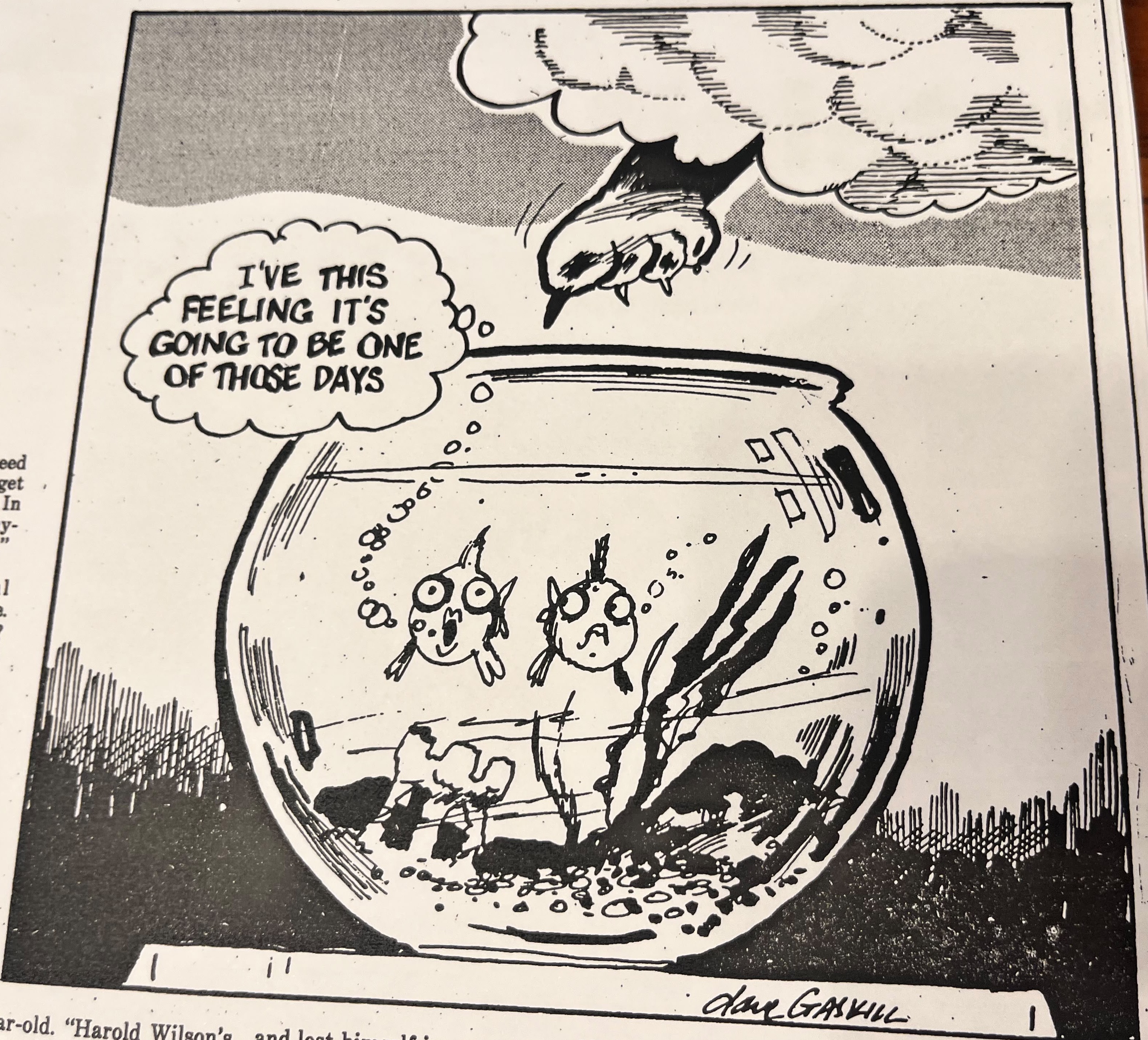
Quietly, happily, peacefully.
Each morning, she’d smile her hello at him, blow him a kiss.
His eyes, large, with a steady gaze that never faltered, would peer at her lovingly. And always, slowly, he’d purse his lips and blow her a kiss in return.
Then, side by side, like an old, married couple, which of course they were to an extent, they’d spend the rest of the day together.
Ambling along, kissing, nudging, touching each other.
I guess, when you love someone, you want to be together.
Theirs was a tender, perfect, sweet relationship. Rare, unspoilt.
And then, most horribly, she was murdered.
Brutally, unsuspectingly, as she was sleeping, she was ripped from her slumber and slaughtered.
My youngest, unmarried daughter of the pansy face and sea-urchin haircut found her body.
She was horrified. “Mummy, Mummy, come here,” she screamed.
I dropped the iron and flew to her side.
There, where she was kneeling, in a dark corner of the lounge, I saw the remains of Cleopatra.
Not that there were many left.
A tail, half a backbone and one small, pathetic fin.
Nicky was beside herself. She clutched me and cried her little heart out.
“Mummy, what do you think happened?” she wailed, her face screwed up, tears running down her cheeks.
It was obvious what had happened. Besides, through the corner of my eye, I could see the perpetrator of this foul deed, sitting on the garden wall licking his whiskers with a contented grin on his face.
How do you explain sudden death to a 10-year-old.
“Nicky,” I spoke gently, carefully. I didn’t want to distress her more than was necessary, but I felt she had to know the truth.
“I think what happened was that Macaroni was hungry, and as he strolled past the fishbowl, he caught a glimpse of Cleopatra and Harold Wilson swimming together side by side.
“Now, you know it’s natural for cats to eat fish — well, I think the temptation was too great for Macaroni. I think his taste buds sent a message down to his stomach, which growled and in return sent one back to his brain.
“And so Macaroni, put his paw into the fishbowl and caught Cleopatra. I’m sure she felt no pain. I’m sure it was a quick demise. Cats are known for their swiftness in hunting.”
Nicky gulped. “I hate Macaroni,” she said passionately. “He’s a horrible cat. I don’t ever want to see him again.”
Then: “Do you think Cleopatra’s in heaven, Mummy?”
This wasn’t the moment to tell her that, right now, I thought Cleopatra was residing in Macaroni’s stomach.
“Yes, I’m sure she’s floating around in the great goldfish bowl in the sky and in fact, right now, I bet she’s looking at you.”
It was an unfortunate thing to say, because Nicky immediately started wailing again.
“How can she be looking at me? Her eye’s lying on the carpet.”
I gazed at Cleopatra’s remains. Sure enough, almost, but not quite covered by the fin, lay an eye.
“Nicky, fish don’t need eyes in heaven. They get around without eyes. In fact they don’t need anything — just their souls.”
That comforted her.
Just then, an awful thought occurred to me. What of Harold Wilson? Had Macaroni eaten him too.
I glanced quickly at the fishbowl and to my relief caught the glint of Harold’s tail as he shimmered around.
“Nicky, I think we should check that Harold Wilson’s OK,” I suggested. I thought it was a good idea to distract her.
Indeed, Harold Wilson seemed fine. He darted in and out of the rocks. In fact, it almost seemed as if he was searching for something. For Cleopatra?
“Mummy, Harold Wilson’s looking for Cleopatra!” Nicky confirmed my thoughts.
We removed the fishbowl and put it next to Nicky’s bed where she watched over Harold Wilson like an anxious mother duck.
After a few days, it was obvious that things weren’t well in the fishbowl.
Harold Wilson was listless, he was off his food and losing weight fast. Even the flip of his tail lacked enthusiasm.
He retreated to a dark corner under the largest rock, where he remained in hiding for hours on end.
“Mummy,” said Nicky, after watching him declining. “Have you ever had a broken heart?”
“Yes,” I answered her, “I have one now, why?”
“Do you think it’s possible for a fish to die of a broken heart?”
“It’s possible, but not probable,” I replied.
“You’re wrong,” she said with the wisdom of a 10-year-old. “Harold Wilson’s mourning Cleopatra — he’s dying of a broken heart and we’ve got to do something, quickly.”
It was obvious that Harold Wilson needed therapy immediately — the therapy of a loving mate.
We shot off to the local pet shop and after much discussion chose a most attractive, largish, golden fish with red streaks along her back and eyes rimmed in black. A vivacious fish.
“We’ll call her Golda Meir,” said Nicky happily on the way home.
Harold Wilson took one look at Golda Meir and retreated under his rock. She followed him. He shot out and lost himself in a water fern.
“Give him time,” I said to Nicky, “some guys don’t like to be rushed, they’ve got to make up their minds in their own way. He’ll either go for her or he won’t — it’s called chemistry.”
It will suffice to say that the chemistry worked, because next morning, we found Harold and Golda swimming together, side by side, nudging, kissing and blowing bubbles at each other.
In fact, only recently the happy couple gave birth to several little goldfish eggs which are now safely ensconced in a special fish incubator lest they come to harm.
Nicky’s captivated by the whole fishy tale and there’s no doubt she’s learnt something.
Why, only yesterday morning I found her writing a school essay which began: “Harold Wilson and Golda Meir gave birth to a love child ...”
■
Editorial note
Masthead: Sunday Express LIVING, September 25, 1983, page 7. The drawing is separately photographed on page-417. Harold Wilson, Cleopatra and Golda Meir are the goldfish in this column.