Carol’s Column
Culture vulture
HE FIRST joined our family about 10 years ago.
Ralph noticed him first.
"Mom, there's a bald-headed thing hopping around the lawn chasing the dogs," he said in his charming, straightforward way.
"It must be your father's side of the family," I replied. "One of his many uncles. Has he got flat feet, too?"
Ralph peered out of the window. "No, but he's quite ugly."
"Definitely one of your father's side of the family," I muttered as I dished up the scrambled eggs on toast.
"They always were a funny lot."
"Mom, he's eating the nasturtiums, I think you should come and look."
I know you marry a man for better or for worse, but to have to put up with his bald-headed nasturtium-eating relative, is stretching things a little far for any young fortyish-or-so bride.
Especially when I'd just planted the pansies among the nasturtiums and mulched and manured.
And if this was anything like uncle Walter, who'd come for a day and stayed for six months, I'd have chicken manure and worse up and down the stairs all day.
There comes a time in any marriage when a partner has to make a stand. I opened the front door, dislodging the new chime bell that had yet to chime, to see a scraggy, bald-headed bird helping himself to the bowl of pet mince mixed with fortified whole-wheat bread and grated carrots.
"That's not your father's uncle," I exclaimed. "That's a vulture. A Cape vulture! What on earth is a Cape vulture doing so far north of the Cape?"
Remembering my scientific responsibilities, I immediately phoned the Society for the Prevention of the Extinction of Cape vultures.
"Look, we have a Cape vulture in the garden — in Parkwood."
The voice was breathless with excitement: "Describe him to me," he said.
"Well, he's utterly bald and his neck skin seems to be light bluish. There's absolutely no doubt this is a Cape vulture en route to Cape Town or the Magaliesberg," I declared.
The Vulture Society was specific. "At all costs, keep him in your garden. Don't let him escape for a moment. This will be a new record, never before has a Cape vulture been found in Parkwood. Good God, there could be a whole colony of Cape vultures nesting in that area. I'll be there immediately.
"Meanwhile, just keep him amused."
Have you ever tried to amuse a Cape vulture? Whenever I approached him, he fluttered his wings, snarled, then hobbled off. I could see he thought we were mad.
We spread a special, enticing dish of steak, bones, fruit and jam sandwiches around the garden, hoping to keep his palate sufficiently interested, in order that he wouldn't fly away.
Culture Vulture, for of course that's what we'd named him by now, seemed quite happy with all the fuss and the attention.
"He can sleep in my room," said Barry, "and Ralph can move into the garden." Which wasn't a nice thing to say about his younger brother.
"Good heavens," I said proudly to my neighbours, who'd come to witness the rare event of a Cape vulture in the Lazar's garden, "look at those hooded eyes — you can just tell he's a bird of prey."
Eventually, the Save the Cape Vulture expert arrived. Complete with net and a massive cage — not to mention the 30 or so Save the Cape Vulture T-shirts (only R3,99) tucked under his arm.
"Right, where is he?" he asked expectantly as he leapt out of his landrover.
"He must be blind," I murmured to the neighbours, "what does he think that is hopping across the lawn?"
Ralph pointed out Culture Vulture, who by now had fallen happily asleep in the dog basket.
The young man roared, bellowed, then guffawed.
"That you call a Cape vulture?" he shouted with glee.
Culture Vulture raised a hooded, beady eye, didn't like what he saw (could you blame him?) and went back to sleep.
"That's an Indian Mynah, a bald-headed Indian Mynah".
"A bald-headed Indian Mynah," we repeated.
"Most Indian Mynahs have thick heads of hair, but there is a fairly rare, but well-known mutation of the Indian Mynah family — and that's him."
"So he's not an endangered Cape vulture?" we chorused weakly.
"No, does he look like one?"
This family of wildlife experts who'd never before seen one in their lives was nonplussed.
To cut a long story short. Culture Vulture, for how could we change his name and cause role confusion in his life, moved under the eaves of our bedroom window 10 years ago.
Where he has bred an entire family of Indian Mynahs complete with mini Mynahs who chitter and chatter the mornings in.
Each dawn, in all his bald-headed splendour, he perches on the window-sill and graciously accepts the tit-bits handed to him.
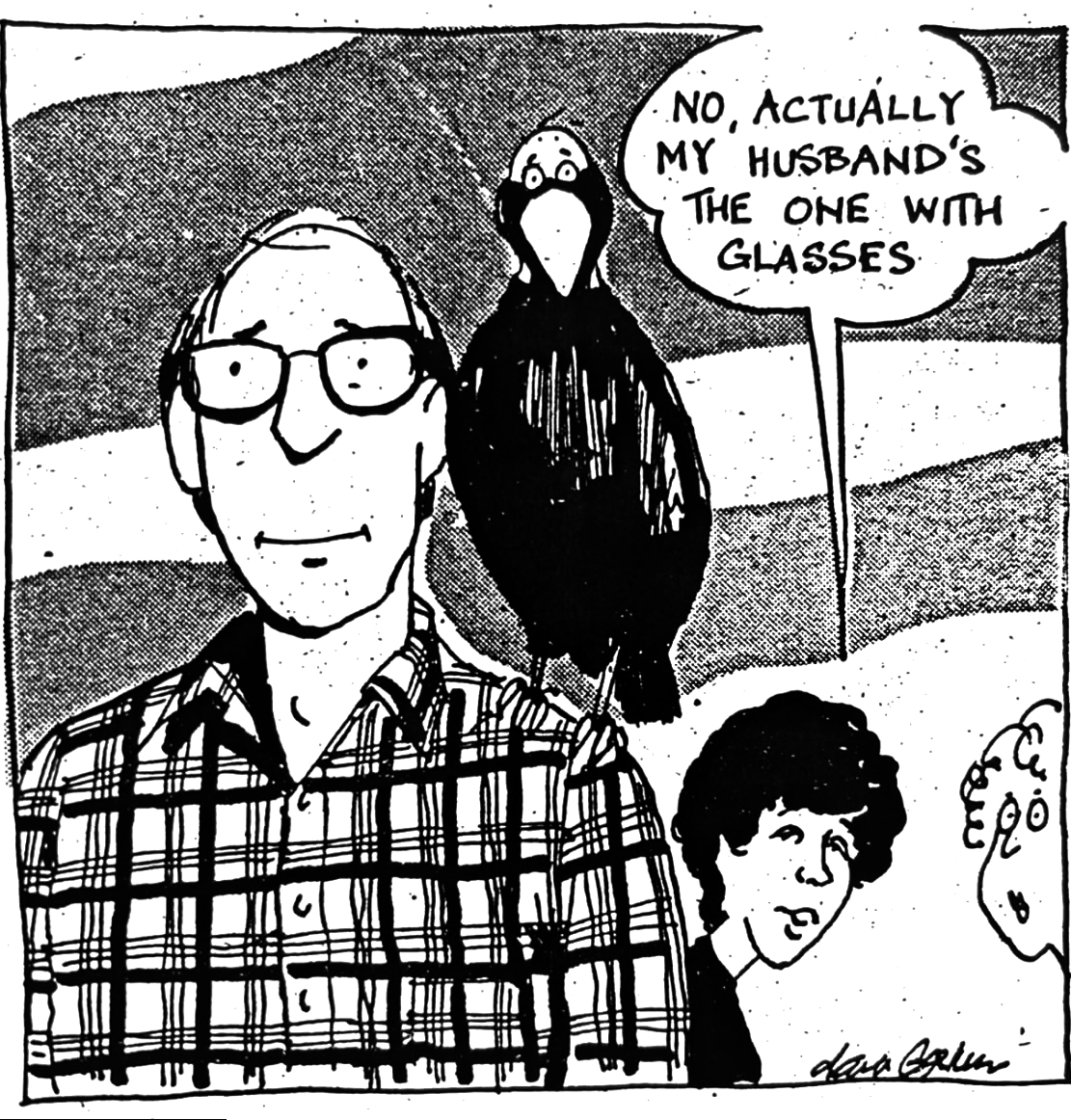
In fact, only this morning, my husband, a remarkably acute observer of wildlife remarked: "You know, he really is a handsome Cape vulture, far better than the real thing."
I have another theory. They always say pets begin to resemble their owners, and there's no doubt that Culture Vulture looks more and more like my husband every day.
■
Editorial note
The cartoon is signed, but the signature is not legible in the photocopy.